
Enhancing the candidate experience for designers in the Ontario Public Service through comprehensive user research of current and past designer employees, findings analysis, and actionable recommendations.
Sector
Government
Client
Treasury Board Secretariat (TBS), Government of Ontario
Team
Dana Patton (XD Lead), Noelle Campbell-Smith (Senior UX Designer), Emily Wong (XD Co-op), Esi Aboagye (OIP), Nadia Mariyan Smith (XD Co-op)
Tools
Miro, Zoom, SharePoint, Alchemer
My Role
I led recruitment, organized and facilitated user research sessions, analyzed qualitative data, helped develop actionable recommendations, and presented our findings to the partner team.
Treasury Board Secretariat
The Treasury Board Secretariat (TBS) is the ministry of the Government of Ontario that is charged with supporting the work of the Treasury Board/Management Board of Cabinet, a joint sub-committee of cabinet that manages the fiscal plan of the government. This includes reviewing and controlling all government spending, approving labour agreements and workforce planning, management of the provincial contingency fund, and overseeing the procedures and directives that guide the operation of the Ontario Public Service.
Project Background
In collaboration with the TBS’s resource acquisition team, my team and I embarked on a user research project to understand the experiences of designers throughout their tenure in the Ontario Public Service (OPS). The goal of the resource aquisition team is to attract top talent and retain skilled service designers within government roles.
Discovery Research
Research Objectives
- What is the working experience of Service Designers in the OPS?
- What attracted Service Designers to the OPS?
- How might we improve work satisfaction of Service Designers so they want to come to, or stay, in government?
Research Methodology
- 25 moderated semi-structured interviews, 90 minutes long via Zoom (recorded sessions).
Research Participants
- 25 employees accross 9 ministries including 19 current and 6 former employees.
- Variety accross time spent in the OPS and their career stage.
Secondary Research
- We conducted light desk research on job satisfaction metrics.
What we Learned
What contributes to job satisfaction? There have been numerous studies about job satisfaction, most have agreed on the main factors contributing to overall job satisfaction for workers. Workplaces addressing most of these factors can attract and retain employees more effectively. The chart below shows our findings based off of the analysis of the interviews we conducted:
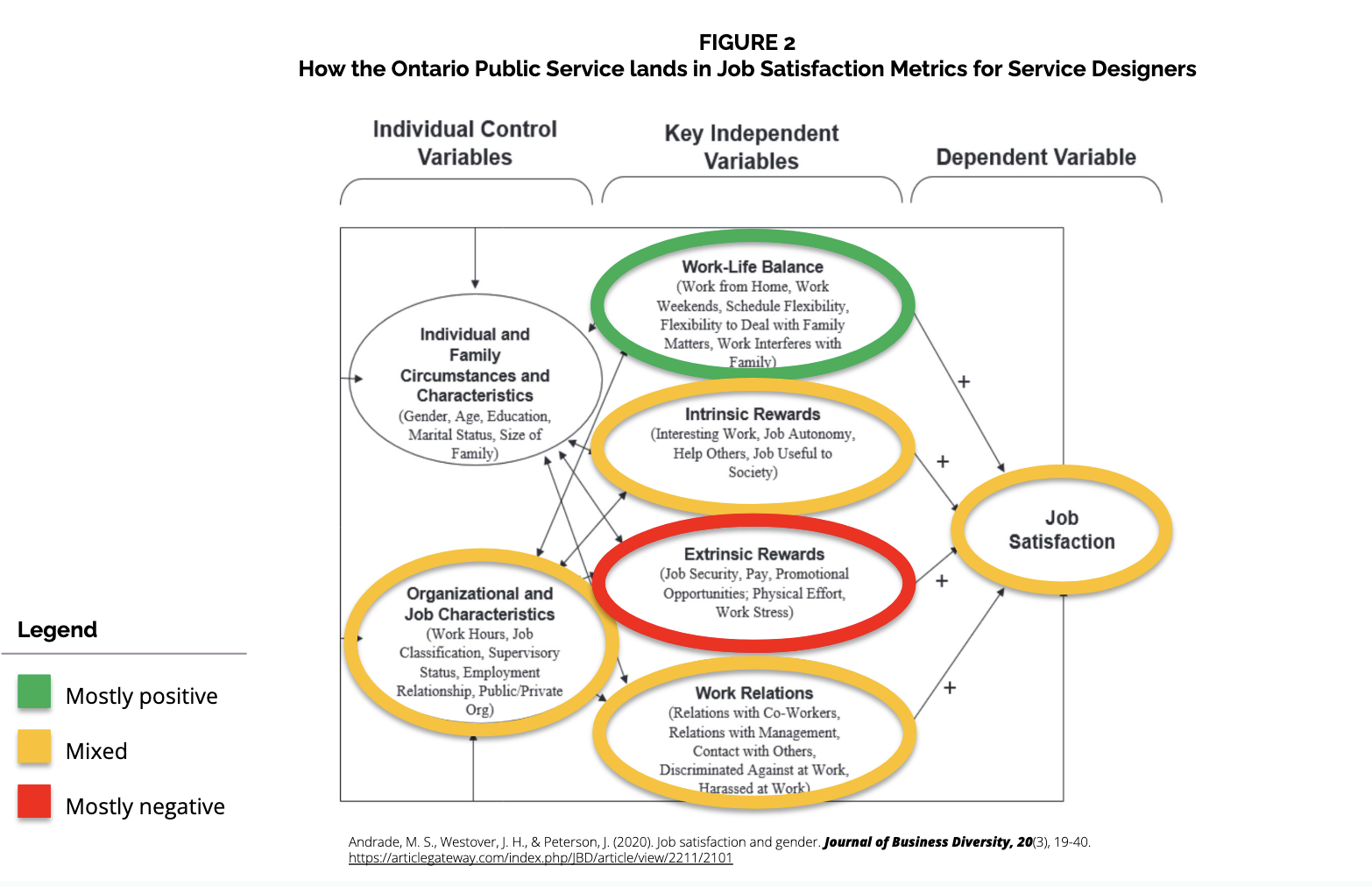
Designers join the OPS with the goal of solving design problems and making a meaningful impact. They thrive when supported by understanding leaders, up-to-date processes, and opportunities for professional growth. However, they face significant challenges including non-competitive pay, bureaucratic obstacles, unclear career progression, and excessive advocacy for their work. Experiences vary by career stage and work environment, but those who see the results of their efforts, have supportive teams and can learn from others are generally more satisfied. Addressing these issues is crucial, as the OPS risks losing talented designers if these challenges are not resolved.
Analysis
We had approximately 37 hours of semi-structured interview data to work through, which required a structured and collaborative approach to synthesis. We used Miro as our central workspace for organizing and analyzing qualitative data.
Tagging & Affinity Mapping
Each team member reviewed transcripts and notes, applying consistent tags based on themes we had aligned on beforehand (e.g., barriers to access, workarounds, emotional responses, needs, and systemic gaps). We made sure to document emerging tags as we went, iterating on the tagging system in real-time to account for new insights.
Once tagging was complete, we exported key quotes and observations into Miro and used affinity diagramming to cluster insights. This process helped us surface shared patterns, outliers, and recurring pain points across participant experiences.
Prioritizing Themes
Through several group synthesis sessions, we translated our clusters into high-level themes that captured what we heard across the board. We prioritized these based on frequency, emotional impact, and relevance to our design or policy goals.
From this analysis, we generated a set of actionable recommendations—each tied back directly to the themes we had identified.
Recommendations
#1 – Highlight the Benefits of Government Work:
What we heard:
People come to government to make an impact, do work that helps society, and collaborate with great people. Job satisfaction is tied to stability, work-life balance, meaningful work, pensions, and generous leave.
What to consider:
Showcase projects with significant social impact to attract mission-driven designers. Emphasize job stability, pensions, and work-life balance as key advantages in recruitment materials.
#2 – Improve Hiring Processes:
What we heard:
Job descriptions are vague, salaries are non-competitive, and postings often lack clear salary ranges. The job portal is outdated, difficult to navigate, and application timelines are unclear.
What to consider:
Standardize job descriptions and titles for consistency and transparency. Clarify salary ranges and set clear expectations during recruitment. Streamline the application process and improve job portal usability.
#3 – Enhance Onboarding Experiences:
What we heard:
New hires often lack necessary tools and devices. There’s confusion around benefit deadlines and inconsistent onboarding experiences.
What to consider:
Create a standardized onboarding framework including buddy systems, clear benefits guidance, and early access to tools. Develop centralized onboarding documentation to ensure consistency.
#4 – Increase Understanding of Design:
What we heard:
Many leaders and clients don’t understand design roles or processes, leading to lower respect for designers. Designers often spend more time advocating for their work than actually doing it.
What to consider:
Train leaders and managers on the value and methods of design. Share best practices and design standards to foster a more informed and supportive culture.
#5 – Build a Stronger Design Community:
What we heard:
Designers often work in silos. Sole practitioners feel unsupported and unaware of existing design communities. The disbandment of ODS was discouraging—even for those who never worked there.
What to consider:
Facilitate regular opportunities for designers to connect, mentor, and collaborate. Reestablish a sense of community similar to what the Ontario Digital Service provided.
#6 – Reduce Bureaucratic Burdens:
What we heard:
Designers face excessive approvals, slow timelines, limited research opportunities, and mandated in-person work that isn’t always productive. Large organizational structures create silos.
What to consider:
Enable consistent user research by creating a blanket approval process across OPS. Advocate for flexible work policies and use in-person time intentionally for team building.
#7 – Expand Career Growth Opportunities:
What we heard:
There’s a lack of clear career paths and not enough senior roles to aspire to.
What to consider:
Introduce roles that allow advancement without requiring management responsibilities. Create leadership tracks for senior designers. Reduce reliance on vendors to free up internal design roles.
#8 – Support Professional Development:
What we heard:
There’s limited access to hands-on learning and little clarity around training funds. Few teams have mature practices or opportunities to explore innovative work.
What to consider:
Allocate time and funding for training and hands-on development. Promote internal development programs and encourage designers to take advantage of them.
#9 – Foster Impactful Work:
What we heard:
Some projects lack visible impact due to slow development or shallow problem definition. Discovery work is often skipped.
What to consider:
Prioritize discovery phases to understand root problems and ensure projects meet real needs. Use metrics to measure the social impact of design work and communicate its value clearly.
Takeaways
- Importance of Focus During Long Semi-Structured Interviews: Our interviews ran up to 90 minutes to allow enough time to understand participants’ experiences deeply. Because we had a large team, we were able to split up facilitation duties, which helped prevent burnout and kept everyone focused during their sessions. We also ensured multiple note-takers were present at each session. This experience taught me the importance of planning ahead, allocating enough time, and distributing work intentionally across team members.
- The Value of a Clear Plan for Analysis: With nearly 37 hours of interview recordings, we needed a strong, shared plan for analysis. We collaboratively developed a tagging framework and used structured synthesis sessions to ensure that key patterns and insights emerged across the entire data set. This taught me how critical it is to plan for synthesis before starting interviews, especially in large-scale qualitative research.
- Working with a Large Team Has Benefits and Drawbacks: A large team made it possible to complete more interviews in less time and bring in diverse perspectives during synthesis. However, it also required significant coordination, consistent communication, and shared documentation practices. This experience taught me how to balance individual initiative with group alignment in collaborative research settings.
Thank you for reading!